Popular Posts

Saturday, April 18, 2009

Collection trip April 09 - a report


The announcement of the trip, the route
On 16th March afternoon, my friend and many years senior in the hobby, Madan Subramanium of Bangalore came out with a collection trip plan. Something we were all expecting and looking forward to. This time it was going to be big. No collection trip of this magnitude has ever happened on India soil before. By this magnitude, I mean, a 15 member team, 5 cars, 3 days 2 nights and 1000+ kms of hard core collection.

It was obviously very rigorous and we had covered nealy 50-60 sites for collection. Good to see was every one of us was ready for the ordeal with high level of interest.

The route for the trip was decided to be,

Check the Map for the location
http://www.mapsofindia.com/maps/karnataka/karnatakaphysical.jpg

10th Friday April 2009
Departure Bangalore : Yeshwantpur Metro 0500 Hrs
drive straight to Shimoga and save time. Quick Lunch at Shimoga.
Post Lunch: Shimoga - Manddagadde, Tirthahalli - Habitat study and collection trip begins from this stretch.
Night halt at Tirthahalli.

11th Saturday April 2009
Departure Tirthahalli 0500 Hrs
Tirthahalli - Koppa- Sringeri – Kudremukh* - Koppa – Tirthahalli
*We will be passing through Kudremukh National Park - absolutely no fish catching in the park. We are actually not allowed to even STOP our vehicles when in the park. Time to drive through the park is limited, clocked and verified by the Forest Dept.
Night halt at Tirthahalli

12th Sunday April 2009
Departure Tirthahalli 0500
Tirthahalli - Nagar - Hosanagara - Riponpet - Shimoga - Bangalore

Accomodation at Tirthahalli on both days, ie., 10th and 11th Nights.

Rules, rules and more rules
Well, in collection trip like these there are some rules which has to be adhered to very very strictly to make it a smooth affair. So that, you can accommodate all the spots with some time in hand, you do not have any major health issues etc etc.

The Basic rules that we follow in these collection trip are;
No diversions for tourist spots.
On Time Departures always.
Late comers catch up on the road.
Food as available and when available on the road.
Do not attempt to carry back all the fish you see. If you don't have tanks setup and ready back at home to accommodate the fish when you arrive, don't carry back any fish with you.
These trips are of real fatigue - if at any time, any one wants to break off they are welcomed to do so, collection trip takes priority over all else.
Passengers liaise with car owners for pick location, time, what to carry etc.

How we keep our fish alive
We diligently follow instructions on the trip. Assign one "water changer" per car.
Fish can be kept alive with zero mortality by following instructions strictly. There is no substitute to hardwork.

Things each car carry
Fish nets, Hand nets, Fish bags, Rubber bands, Small 3 liter bucket, Styrofoam boxes, Mug.
Plenty of Drinking water. Snacks. Umbrella, Hand towels, Towels, Dark glasses, Head gear, First AId Kit.
Car Papers and Insurance docs, Driving License. ID card. CASH.

Clothes to carry
Only comfortable clothes. Only cottons. Shorts and T- shirts are the thumb rule.
Plenty of extra inner wear. You will need it.
Proper water proof footwear. Keds/canvas shoes or strap ons.

Keep handy
Always carry a one liter bottle of drinking water by your side. Dehydration is always very high.
If you have delicate skin, get lotions for it. Make sure you use the lotion only when you are not handling the fish or getting into water.

Know your limits.

Model Code of Conduct
1. Prone to car sickness ?, take an Avomin tablet one hour before the trip starts.
2. No booze during the day. Smoking is as per the car owners discretion.
3. Food is last priority, carry food if you want meals on time. Eat same on the drive, no special stoppages.
4. Don't spare anyone, sarcasm & wit rule ! Take & Give back all that you get all day long. No hard feelings at the end of the day.
5. Don't sit with wet clothes on the car seat. Carry a large plastic sheet with you.
6. Do not step bare foot into water. Carry chappals if you are coming in shoes.

Following these simple yet mandatory rules we have managed to have the most satisfying trips while managing to bring back and rejuvenate almost 100% of wild caught live stock.

You can see the tour pictures
http://www.orkut.co.in/Main#Album.aspx?uid=3890438703860345209&aid=1239971381

Hope this helps all you guys. If it helps you, please drop a comment.

Wednesday, April 1, 2009

Understanding Full Spectrum Aquarium Lighting

http://www.aquatic-eden.com/2007/12/understanding-full-spectrum-aquarium.html

Picking the right lighting for your planted aquarium can be intimidating and confusing. There are so many options to choose from, and so many ways to measure these options. The first step to understanding full spectrum aquarium lighting is to understand what type light your plants need, and what the measurements mean.

Color temperature, measured in Kelvins, is often the easiest measure to find, after wattage. It is a measure of the overall color of the light as it appears to the human eye. Lower color temperatures appear reddish while higher temperatures appear bluish with white in the middle of the range. Often, a temperature between 5000K and 10,000K is recommended for a planted aquarium. However, two bulbs with the same color temperature may in fact be emitting very different light, some more useful to plants than others. This has to do with the different wavelengths of light, and explains why relying on color temperature alone can be misleading.

Visible light is made up of many different wavelengths, mixed together. It's the absorption or reflection of particular wavelengths that produce colors. Plants require certain wavelengths of light to carry out photosynthesis using chlorophyll. The light that chlorophyll absorbs is used to power photosynthesis. By examining the wavelengths of light absorbed by chlorophyll, we can begin to understand the needs of our aquatic plants.

As shown above, plants need the majority of the light to be around 400-450nm and 650-675nm (or blue and red light). The blue light is used for leaf growth, and promotes bushy, compact growth, while red light is mainly used for flowering and strong stems. They reflect most green light, thus explaining why leaves are green.

Armed with this information, we know that any aquarium light will need to produce large amounts of blue and red light. Most bulb manufacturers include the spectral output graph of their products on or in the packaging. Examine this output graph and try to find a bulb that matches up with the spectral absorption graph for chlorophyll. The closer the match, the better the bulb will be for your plants. For example, the following graph is for a GE 9325K bulb.

The bulb matches up fairly well, although the spike at 600nm is not really red enough (650-675nm) for a plant to fully benefit. The blue light spike is however beneficial, and the spike in greenish-yellow light will make the bulb look bright to the human eye.

Although you may not notice a major difference between bulbs, a mix between a color temperature that you like and a spectral output that your plants like will help create healthier plants and a healthier aquarium.


For more in-depth information on the science of full spectrum aquarium lighting, check out this discussion of aquarium lighting science and photosynthesis, or this aquarium light bulb comparison study. For more information on lighting metrics, check out this page on Kelvin, nanometers, PAR, and CRI.

Eheim 2217 Review

http://www.aquatic-eden.com/2006/09/eheim-2217.html


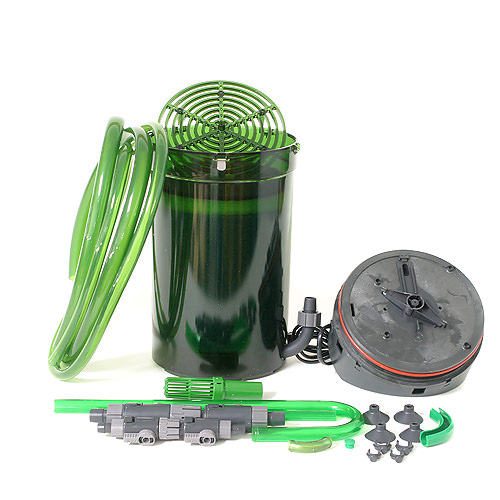
The Eheim 2217 is the largest of the Classic series you can buy. It's rated at 264 gallons per hour and the filter itself is a hefty 6 liters (roughly 1.5 gallons). This is significant because the volume of the filter container determines how much media you can put in and the more media, the more filtering capacity. Many people mistakenly think that the flow is what determines what size tank a filter can handle. Although this holds true in some cases, larger filter volume will always mean larger filtering capacity. It doesn't matter how fast you push water through a tiny container, it will only have so much media that can do the job. Although the 159 gallon rating may be a bit optimistic (like the 2213's 66 gallon rating), this filter can certainly get the job done on any tank below its upper limit.

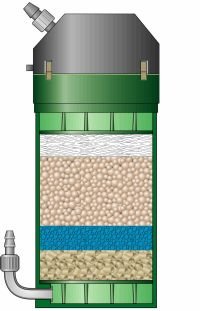
If anyone asks you why an Eheim is one of the best filters available today, you can point to the flawless German engineering and efficiency. The 2217 only uses 20 watts to push all that flow; comparable filters use 25 or more. There is also absolutely no bypass. The way the filter is designed
means that all water must pass through the media. Any dirt that gets sucked up by this filter remains in the filter.

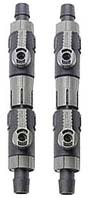
The quality of the parts and construction is top notch. When you clamp the lid onto the container, you know it wouldn't leak, ever. Not even if you tried. In fact, you can even run it without half the clamps and it still won't leak. Priming the 2217 for the first time can be a bit of an ordeal (like any of the Classic series). These filters don't come with any of the fancy self-priming buttons or levers, but they do come with double-tap valves, which make all the difference. However, the first time you set it up, you will funnel (Eheim sells a bulb to do this) or, with much regret, suck on the intake tube. Once you have it filled and running, all you have to do is close the valves on the double-tap connectors, unplug the filter, then separate the connectors. The water remains in the tubing and in the filter, so when you're finished, just reconnect everything, open up the valves, and turn it on. No priming ever again!

My 2217 came with free media, as I think most do at this point. It came with 1 fine pad, 1 coarse pad, 1 carbon pad, Ehfimech, and Ehfisubstrat Pro. These are all top notch, and the Ehfisubstrat Pro is specially shaped so it doesn't compact and clog. They provide mechanical, biological, and chemical filtration. Again, nothing gets by this media. It also came with tubing and tubing accessories including a spraybar, an intake tube with strainer, and suction cups. It includes a plastic elbow piece which I believe is an alternative to the sparybar, but quite frankly, if you decided to use it it'd be like putting a fire hose in your tank; heaven help the poor fish who unknowingly swims in front of it.

Eheims are probably the best filters you can buy, if you have the money. The 2217 usually retails for around $150 but is well worth it, as these filters have been known to last for decades. I give it five out of five fish:


Pros: Efficient, high quality, no bypass, large filtration capacity

Cons:
First time priming can leave a fishy taste in your mouth

Substrates for the Planted Aquarium

http://www.aquatic-eden.com/2007/04/substrates-for-planted-aquarium.html

he Planted Aquarium

Choosing the right substrate for your planted aquarium is an important decision that will have long term affects on your plants. Although the impacts may not be as immediately visible as say lighting or CO2 choices, the substrate in your planted aquarium is a critical part of your aquarium's ecosystem and vital to the health of your plants. There are many different options, all of which have benefits and drawbacks, but I'll highlight some of the most popular options. Overall, there are a few basic requirements that must be met to be appropriate for a planted aquarium:

  • A planted aquarium substrate should not be too large or too small (usually between 3-8mm per grain). This is to accommodate root growth; grains that are too small will suffocate and crush roots while large grains won't provide enough contact with the roots.
  • A planted aquarium substrate should not affect the water chemistry negatively. Many substrates are designed for other uses, including salt water use, and may leech minerals and salts into the water. For example, crushed coral leeches calcium into the water of an aquarium. This can raise the pH and KH (carbonate hardness) in a freshwater planted aquarium to damaging levels. Substrates that maintain a constant pH level may also be undesirable, as different plants thrive under different conditions, and changing a substrate is probably one of the most difficult procedures to complete in an established aquarium.

The most valuable input and feedback on popular planted substrate brands comes from hobbyists themselves, and much of this information has been taken from planted aquarium forums. Therefore, you'll get much more information than just what it says on the label. If you have a chance, do a search for planted aquarium substrate or one of the following brands on a planted aquarium forum, such as Aquatic Plant Central. Just remember to take what you find with a grain of salt, as these are often extremely un-scientific reviews.


Planted Aquarium Specific Substrates


Eco-Complete
$20-25 for a 20lb. bag

One of the top planted aquarium substrates today, Eco-Complete is a balanced, easy to use substrate. It comes populated with beneficial bacteria, so if you are starting a new tank, you can jump-start the cycling process. It also doesn't require rinsing, which is a big pain to have to do, and an even bigger pain later if you don't do it! It comes packed with essential nutrients and minerals required for live plants and shouldn't impact your water parameters (Unless you bought a really old bag, as they did have a few quality problems about a year ago. These can be identified by milky white liquid in the bag, but they will replace the bag for free). The grain sizes are within range for optimal root growth and the appearance is of a deep black sandy gravel. It's also rounded gravel, and poses no threat to bottom feeding fish which may hurt themselves on sharp edged substrate. I use Eco-Complete almost exclusively, and for the price, you can't buy a better substrate in my opinion!


Flourite
$15-20 for a 15lb. bag

Flourite has been around for a while and is not as technologically advanced as other substrates available now but is still an old stand by. It is a clay based substrate with a reddish color that comes from its high iron content. The major drawback with Flourite is that is needs to be rinsed extensively before putting it in the aquarium, otherwise it will severely cloud up the water. It's also larger than other planted substrates and may pose a problem for plants with small, delicate roots. It doesn't have as much or as many minerals and nutrients as other planted aquariums substrates available today. However, you can't really go wrong with Flourite: it's tried and true.

ADA Aquasoil
$26 for a normal type 9L bag (roughly equivalent to a 15lb bag) from ADG

Supposedly the best planted substrate money can buy, Aquasoil is researched and manufactured by Takashi Amano's Japanese company, ADA. There are several different varieties, based on biotopes from around the world. These range from Amazonia to Malaya and Africana, all with different colors and properties to simulate the biotope for which they are named. Made up of round grains, the substrate maintains gaps allowing for water circulation to prevent roots from suffocating, although now they also sell a powdered version to make the top level of the substrate more attractive. It's engineered to lower the pH and general hardness (GH) of the water (this effect is not to be confused with the lowering of pH associated with adding CO2; simply lowering the pH using Aquasoil is not adding any CO2!). Most plants grow better at a lower pH of about 5.5-6.5. If that weren't enough, Aquasoil also acts as a passive filter, capturing floating particles. Nobody knows exactly what it's made of, but it maintains its shape long-term and provides nutrients for root feeders. I haven't been feeling wild enough to start a tank with Aquasoil yet (even though the price is now quite competitive) but others who have swear by it. If you don't have a large tank, or like knowing you bought the best money can buy, Aquasoil is for you.

Soil
Cheap!

Diana Walstad's book, Ecology of the Planted Aquarium, is your bible for using regular potting soil. Most people who use soil are following her methods to create a "el Natural" style aquarium. The benefits of this style is that it requires very little maintenance or fertilizing. However, using soil submerged can be very challenging and there are many ways to do it wrong, leading to certain disaster. Like in nature, a soil substrate does grow plants very well. If you plan to use soil, definitely read her book or ask around on planted aquarium forums for advice!

Traditional Substrates

Regular Inert Gravel
$10-15 for a 20lb bag

Believe it or not, regular intert gravel can also be used quite successfully as a planted aquarium substrate. More intensive fertilization will have to be done to maintain more demanding plants, but it is possible. If going this route, try to get smaller gravel as most gravel sold will be large and difficult to root small delicate plants and stem plants with shallow roots. If you already have an established aquarium with gravel, this is ideal, as the fish mulm has already accumulated in the gravel and will act as a fertilizer. If you are starting from scratch, root tabs or other substrate fertilizers can be used to give plants a boost until the mulm builds up.

Sand
$5 for 20lbs or less

Sand must be used with caution as a planted aquarium substrate. It is very attractive, but has many downsides. First, it tends to compact, making it very difficult for roots to grow into it. Secondly, this compacting can lead to reduced circulation and pockets of anaerobic (not requiring oxygen) bacteria thriving, creating toxic gas bubbles. To prevent this, it's best to either layer one of the other planted aquarium substrates underneath the sand or use a very large grain sand. Overall, sand is best reserved for an accent area, creating a sandy beach effect, and is not ideal for growing plants.

Substrates to Avoid

Red Sea FloraBase

I almost bought this planted aquarium substrate as it was attractive and not too expensive. However, I looked up other's thoughts online and found out that although it is a great planted aquarium substrate for the first year or so, it requires replacing (it even says so on the label). Otherwise the granules, shaped similarly to ADA Aquasoil granules, will begin to lose their shape and "melt" into mush. This can be disastrous. Coupled with the fact that changing the substrate in an established tank is all but impossible without totally destroying it, this planted aquarium substrate is one to avoid unless you tear down your aquariums every year.

Laterite (Cat Litter)

This is not really a substrate but more of an additive to substrate. It is a form of clay that contains iron and acts as a sponge to store nutrients, but is meant to be mixed into the existing substrate (usually inert gravel). However, it is clay, and thus gradually softens into a mud-like substance that if disturbed, will cloud your tank dramatically. If, like me, you move plants around frequently, this can mean a cloudy tank all the time.


So these are the top planted aquarium substrates and those to avoid as a planted aquarium substrate. There are many more options, but these are less common and more experimental. You can find an infinite number of combinations of materials and their performances on planted aquarium forums. As for substrate depth, 2-3 inches is generally the rule of thumb. Shallower than that will lead to problems with roots not being able to go deep enough and it will be hard to anchor plants. Much deeper...well why would you make it much deeper? You're keeping a fish tank, not an ant farm! Good luck!

Dutch Vs. Nature Style Aquariums

http://www.aquatic-eden.com/2007/02/dutch-vs-nature-style-aquariums.html

In the world of aquascaping and planted tanks, there are two major schools of thought: the Dutch style and the Nature style (also called Japanese style, but not to be confused with the el Natural style which is not a style of aquascaping but an entirely separate approach to keeping a planted aquarium). Both are popular styles that are based on the arrangement of plants in the aquarium and the way it is aquascaped and are by no means the only way to aquascape a tank. Most hobbyists choose to loosely follow one school based on their own personal preference of what they think looks better.


Dutch aquariums are an older style of aquascaping, dating back to early 20th century Holland. The style focuses on neat rows of plants radiating out from a central focal point, with lower plants in front and taller plants in the back (creating depth). You'll often see this described as "streets" or "avenues" using plants.


Dutch aquascapes also feature more colorful aquatic plants. They can be likened to a well kept garden, where all the plants are arranged with a purpose and kept well trimmed and defined. It may not be the most natural looking, but it is extremely beautiful and visually interesting. A significant hardscape (rock and/or driftwood) is usually not present or visible. Color, contrast, and the beauty of the individual plants is paramount.


The Nature aquarium style was pioneered by Takashi Amano in the last decade. The style of this type of aquascape is very much focused on nature and imitating both natural landscapes and snapshots of natural environments. This means that a Nature style aquascape can look like a miniature version of a mountain range with tree lined slopes, or like a scene under the surface of a small river.


Hardscape usually plays a role in framing the aquascape or helps to create flow. Nature style aquascapes are often also one of three shapes: concave shaped, convex shaped, or triangular. Concave means that the height of the plants decreases to some central low point, then slopes back up. Convex is the opposite of concave, and is often called an "island" shape since the plants are low on either side but high in the middle. Finally, triangular shaped aquascapes are shaped like a right triangle, and the height of the plants slopes gradually from high on one side of the tank to low on the other. In most Nature style aquascapes, there is only one main focal point and it is almost always positioned according to the Golden Rule. Natural appearance, flow, and other Japanese gardening principles are most important

Within each of these styles there are further sub-styles that I'll explore a little further in another article.

Do's and Don'ts of Water Changes in the Planted Aquarium

http://www.aquatic-eden.com/2007/03/dos-and-donts-of-water-changes-in.html

I recently received an email from a reader concerning water changes in a small 1 gallon planted aquarium. She was planning on keeping a few Heterandria formosa (tiny live bearing fish, pictured above) and live plants but had some questions about water changes:

But I can't figure out, how often and how much for water changes? Will water changes in this circumstance harm the system more than help it? What do you think?

This got me thinking. Why not write a post on the do's and don'ts of water changes in the planted aquarium? So, here they are:


Do change 30-50% of the aquarium's water every 1-2 weeks. This is variable based on fish load and filtration, but not on the aquarium's size. From 1 gallon to 100 gallons, 30-50% is a good rule of thumb. This removes all the toxins and excess nutrients that build up in the water.

Don't rely on filters to clean the water. Filters don't remove excess nutrients and toxins from the water, they just trap it so it can be removed easier when you clean your filter. However, filters also can't remove many things effectively.

Do make sure the water you use to fill the aquarium back up is the same temperature as the aquarium water. Drastic changes in temperature stress the fish and can lead to disease and even instant death in extreme cases.

Don't forget to add a water conditioner that removes chlorine and/or chloramines if you are using tap water. These can kill fish and even plants if not removed. Water conditioners also often remove heavy metals such as copper that may harm plants and fish.

Do water changes after courses of medication, after stirring up the substrate doing a re-scape, or after accidentally overdosing anything, including fertilizers. Water changes help to "reset" the aquarium by removing dissolved waste and chemicals. They are often a cure-all for many aquarium related problems, and rarely cause harm if done in moderation.

Don't remove more than 50% of the water during a water change if you can help it. Sometimes, more than 50% is needed in extreme cases (such as ammonia spikes or overdoses), but this can put stress on the fish and the beneficial bacteria in the aquarium. It can lead to rapid changes in water parameters (such as pH) that are as stressful to fish as rapid temperature changes.

Benefits of Plants in the Aquarium

http://www.aquatic-eden.com/2007/01/benefits-of-plants-in-aquarium.html

While surfing around the other aquarium websites on the internet, most dealing with fish only freshwater aquariums, I noticed that a large part of keeping a fish only aquarium is trying to overcome the drawbacks of not having live plants. It also made me realize how hard it was to actually keep fish when I still had a fish only aquarium. Diseases such as Ich were commonplace, and although the medicine was available to treat the diseases, I still invariably lost a few fish along the way. This never struck me as strange until now. Instead of desperately trying to keep the fish alive, in a planted aquarium the goal shifts to keeping the plants happy. If the plants are happy, the fish thrive. This is due to the immense benefits that keeping live plants in an aquarium can bring, including:


Aeration - Fish only aquariums are often aerated with an airstone in a desperate attempt to keep oxygen levels high so fish can breathe. In a planted aquarium, as in nature, the live plants provide all the oxygen your fish will ever need through photosynthesis. An airstone and air pump (and all the noise and vibration that go along with them) are unnecessary in a planted aquarium.

Filtration - Power filters, sponge filters, and canister filters are the only means of filtration in a fish only aquarium. It's up to these filters to remove all fish waste and waste produced by excess food. This is achieved through mechanical filtration, chemical filtration (via carbon), and biological filtration (via bacteria growing on the filter media). There are many designs of filters out there and some are better than others, but all suffer from one flaw: if not cleaned properly and regularly, their effectiveness drops. In a planted aquarium, on the other hand, only mechanical filtration is truly needed. Plants can handle chemical and biological filtration fairly well. They absorb chemicals that are harmful to fish (in fact they live off of the chemicals produced by fish waste) and provide a perfect medium for beneficial bacteria to grow on. Of course, plants have their limits of filtration as well and most planted aquariums have a back up filter providing mechanical and biological filtration. Chemical filtration in the form of carbon will remove beneficial compounds and fertilizers needed by plants, and is not advised for a planted aquarium.

Protection - In fish only aquariums, the focus is the fish themselves, and their environment can be somewhat neglected. Not having enough protection can cause fish to be stressed and more succeptable to disease. Although artifical decorations and plants can be bought and put in the aquarium to provide protection and cover for fish, they are inferior to real plants in many ways. First, they provide none of the benefits listed so far aside from a location for beneficial bacteria to colonize. Second, they are much more likely to injure fish. Live plants aren't hard and don't have sharp edges like plastic plants can.

Food Source - The only source of food in a fish only aquarium is the owner of the aquarium (aside from algae for algae eaters). That means the fish are entirely dependent on you and the food you give them. If you don't make wise choices and vary their diet, they may not be as healthy and can become more succeptable to disease. Also, if you forget to feed them, they have no alternative food sources. In a planted aquarium, the fish have a choice. Although not all fish will eat plants, most will pick at the leaves and dead or dying plant matter if no other food is available. It also helps to vary their diet. Many fish are omnivorous and need to eat plant material.

Algae Prevention - Algae is often a problem in fish only aquariums, and although keeping algae eaters and scraping the glass with an algae scraper are ways of combatting some algae, other types of algae are more stubborn. Algae occurs because there are nutrients in the water and there is light (even low light). In a planted aquarium, plants can outcompete algae and use up all of the nutrients in the water. Although this can open up a whole other can of worms while you try to get your light levels and nutrient levels right, once you get your planted aquarium balanced, you will most likely never have to clean the glass or pull algae off the gravel again.

And there you have it. These are only the practical benefits I can think of, there are many many more benefits to owning a planted aquarium, and it's easier than you may think. Even just a few floating plants can make a serious impact in the health of your fish and the tank as a whole. So what are you waiting for? Throw out that noisy air pump and dirty airstone, toss the neon pink plastic plants and cheesy castle decoration, and take the plunge into a planted aquarium. Your fish will thank you!